

Intro
Let’s stop the platform fanboyism. If you’re a manufacturer looking to digitize your sales, you’ve probably been bombarded with sales decks from Shopify and BigCommerce. Both claim to be the “all-in-one” solution for B2B. Both are lying.
The truth is, neither platform is perfect. Choosing between them is about selecting the right set of technical trade-offs that won’t break your specific operational logic. As an architect, I don’t care about the branding—I care about how these systems talk to your ERP and how they treat your customers’ data.
1. Shopify Plus: The Polished Engine with “B2B-lite” Logic
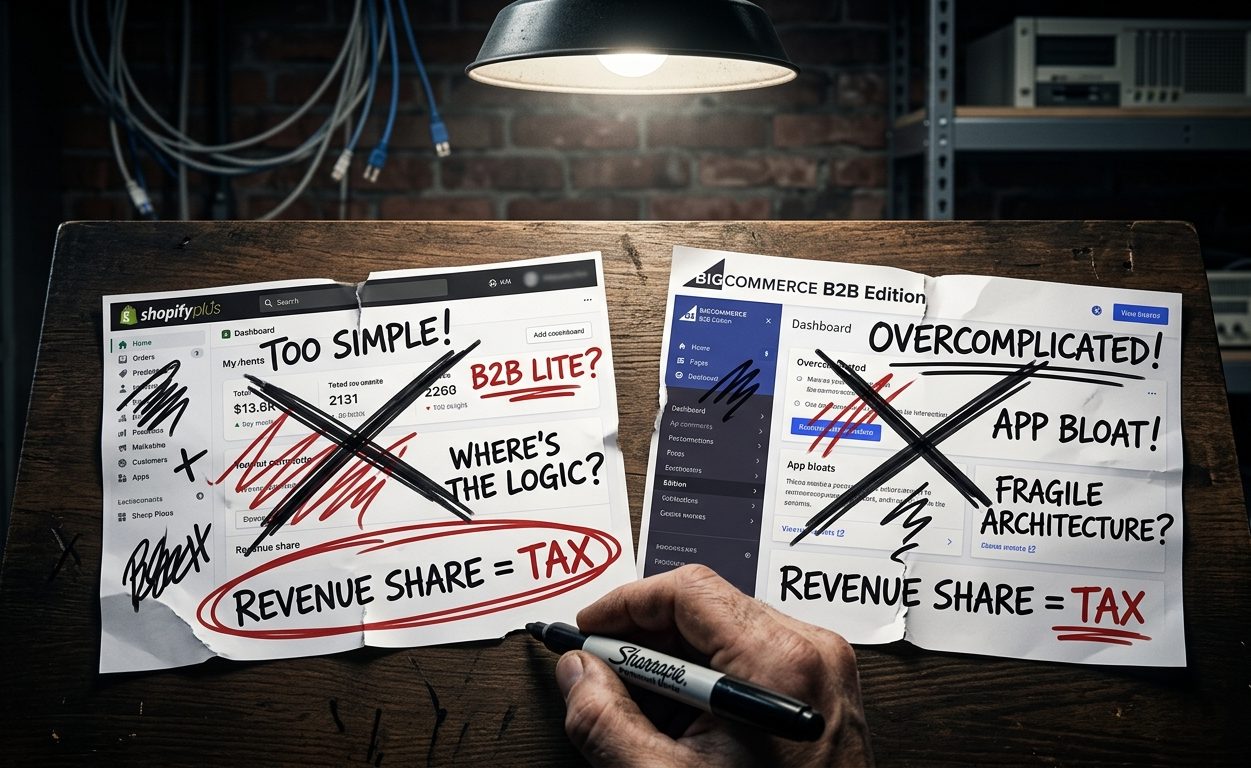
Shopify Plus is the most stable and user-friendly engine on the market. Its ecosystem is massive, and its reliability is legendary. But here’s the catch: Shopify was born as a D2C (Direct-to-Consumer) platform. Its B2B functionality is effectively “bolted on.”
The Strength: Unmatched stability and a slick interface that your marketing team will love.
The Pain Point: If your pricing logic is a nightmare of volume tiers, customer-specific discounts, and tax exemptions, Shopify’s native tools will feel like a straitjacket.
The Architect’s Verdict: I choose Shopify Plus when a client wants a rock-solid core and has the budget to build a custom Middleware layer. We use Shopify for the “shell” and the checkout, but we build the complex brain elsewhere.
2. BigCommerce B2B Edition: The Industrial Workhorse
BigCommerce took a different route. By acquiring and integrating BundleB2B, they offered a much deeper set of native features right out of the box. We’re talking about nested corporate accounts, sales rep masquerading, and native quote management.
The Strength: It handles complex B2B hierarchies much better than Shopify without needing 20 third-party apps.
The Pain Point: The interface can feel “heavy” and less intuitive. Also, managing multiple storefronts across different regions requires a very disciplined approach to data architecture, or you’ll end up with a fragmented mess.
The Architect’s Verdict: This is the go-to choice for companies that need deep, native B2B functionality and want to minimize custom coding. It’s for the “power users” who aren’t afraid of a more complex admin panel.
3. The Elephant in the Room: The SaaS “Tax”
I’ll be blunt: I’m not a fan of revenue-share models. Both platforms want a piece of your pie. It feels like a tax on your growth. However, in 2026, building a custom B2B engine from scratch is a one-way ticket to technical bankruptcy.
My role is to ensure that the efficiency we gain from these platforms—the automation, the reduced manual errors, the 24/7 self-service for your dealers—far outweighs the cost of the “SaaS tax.”
Conclusion: How to Decide? Don’t choose based on a demo. Demos are designed to hide the scars. Choose based on your ERP.
If your ERP is the absolute source of truth and you just need a stable “window” for customers, go with Shopify Plus (and a good architect).
If you need the platform to do more of the heavy lifting regarding account hierarchies and quoting, BigCommerce B2B is your best bet.
Still confused? You should be. It’s a complex decision. Let’s look at your data structure before you sign any multi-year contracts.
Let’s stop the platform fanboyism. If you’re a manufacturer looking to digitize your sales, you’ve probably been bombarded with sales decks from Shopify and BigCommerce. Both claim to be the “all-in-one” solution for B2B. Both are lying.
The truth is, neither platform is perfect. Choosing between them is about selecting the right set of technical trade-offs that won’t break your specific operational logic. As an architect, I don’t care about the branding—I care about how these systems talk to your ERP and how they treat your customers’ data.
1. Shopify Plus: The Polished Engine with “B2B-lite” Logic
Shopify Plus is the most stable and user-friendly engine on the market. Its ecosystem is massive, and its reliability is legendary. But here’s the catch: Shopify was born as a D2C (Direct-to-Consumer) platform. Its B2B functionality is effectively “bolted on.”
The Strength: Unmatched stability and a slick interface that your marketing team will love.
The Pain Point: If your pricing logic is a nightmare of volume tiers, customer-specific discounts, and tax exemptions, Shopify’s native tools will feel like a straitjacket.
The Architect’s Verdict: I choose Shopify Plus when a client wants a rock-solid core and has the budget to build a custom Middleware layer. We use Shopify for the “shell” and the checkout, but we build the complex brain elsewhere.
2. BigCommerce B2B Edition: The Industrial Workhorse
BigCommerce took a different route. By acquiring and integrating BundleB2B, they offered a much deeper set of native features right out of the box. We’re talking about nested corporate accounts, sales rep masquerading, and native quote management.
The Strength: It handles complex B2B hierarchies much better than Shopify without needing 20 third-party apps.
The Pain Point: The interface can feel “heavy” and less intuitive. Also, managing multiple storefronts across different regions requires a very disciplined approach to data architecture, or you’ll end up with a fragmented mess.
The Architect’s Verdict: This is the go-to choice for companies that need deep, native B2B functionality and want to minimize custom coding. It’s for the “power users” who aren’t afraid of a more complex admin panel.
3. The Elephant in the Room: The SaaS “Tax”
I’ll be blunt: I’m not a fan of revenue-share models. Both platforms want a piece of your pie. It feels like a tax on your growth. However, in 2026, building a custom B2B engine from scratch is a one-way ticket to technical bankruptcy.
My role is to ensure that the efficiency we gain from these platforms—the automation, the reduced manual errors, the 24/7 self-service for your dealers—far outweighs the cost of the “SaaS tax.”
Conclusion: How to Decide? Don’t choose based on a demo. Demos are designed to hide the scars. Choose based on your ERP.
If your ERP is the absolute source of truth and you just need a stable “window” for customers, go with Shopify Plus (and a good architect).
If you need the platform to do more of the heavy lifting regarding account hierarchies and quoting, BigCommerce B2B is your best bet.
Still confused? You should be. It’s a complex decision. Let’s look at your data structure before you sign any multi-year contracts.